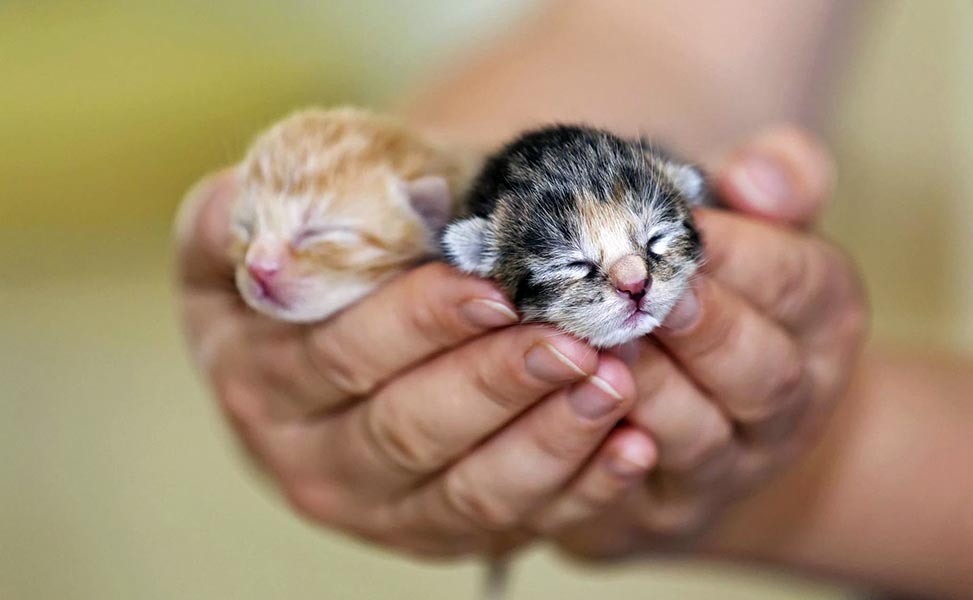
Knowing how to feed a newborn or very young kitten — especially one separated from its mother — is the difference between survival and serious decline. The technique, timing, and formula choice all matter more than most people realize. Here is a practical guide for the first weeks of life.
When a Kitten Needs Hand-Feeding
A kitten that cannot nurse from its mother requires human intervention immediately. Signs that a kitten needs supplemental or replacement feeding:
- Mother is absent, deceased, or rejecting the litter
- Kitten is visibly smaller than littermates and losing weight
- Kitten cries constantly despite available mother
- Kitten is cold, lethargic, or not latching
A healthy newborn kitten doubles its birth weight in the first week. Birth weight is typically 85 to 120 grams. If weight gain stalls or reverses, intervention is required.
What to Feed a Newborn Kitten
The only appropriate food for kittens under 4 weeks is kitten milk replacer (KMR). This is available at most pet stores in both powder and liquid form. Common brands: KMR (PetAg), Beaphar, Royal Canin Babycat Milk.
Do not use:
- Cow’s milk — too low in protein, causes diarrhea
- Human infant formula — wrong nutritional profile
- Goat’s milk — borderline acceptable short-term, but not ideal
- Homemade raw-egg recipes — salmonella risk; adequate only in true emergencies
Emergency formula (only when commercial KMR is unavailable):
Mix 1 egg yolk + 240 ml whole cow’s milk + 1 drop pediatric liquid vitamins. Use only until proper KMR is obtained — within 24 to 48 hours if possible.
Feeding Technique: Step-by-Step
- Warm the formula to 35 to 38 degrees C (body temperature). Test a drop on your wrist — it should feel neutral, not hot or cold. Discard any unused formula after 24 hours; do not reheat leftovers.
- Position the kitten face-down on a warm surface, mimicking how it would nurse from its mother. Never feed on its back — formula can enter the lungs (aspiration pneumonia is a leading cause of death in bottle-fed kittens).
- Use a kitten nursing bottle with a small, flexible nipple. For kittens under 2 weeks, the nipple hole may need to be enlarged slightly — a drop should form when the bottle is inverted but should not flow freely.
- Let the kitten suckle at its own pace. Do not squeeze the bottle. Feeding takes 5 to 10 minutes per session.
- Stimulate elimination after every feeding. Use a warm, damp cotton ball or cloth to gently rub the genital area for 30 to 60 seconds. Kittens under 3 weeks cannot eliminate without stimulation. This is essential — a kitten that does not urinate or defecate will die.
- Weigh after each feeding for the first two weeks. A kitchen scale accurate to 1 gram is sufficient. Record weights — gradual daily gain is the primary indicator of adequate nutrition.
How Much and How Often
| Age | Frequency | Amount per feeding |
|---|---|---|
| 0-1 week | Every 2 hours (including night) | 2-6 ml |
| 1-2 weeks | Every 2-3 hours | 6-10 ml |
| 2-3 weeks | Every 3-4 hours | 10-14 ml |
| 3-4 weeks | Every 4-5 hours (one night feeding can be skipped) | 14-18 ml |
The kitten should feel full but not bloated after feeding. A distended, hard belly indicates overfeeding. A persistent hollow feeling on the sides of the abdomen indicates underfeeding.
Starting Solid Food (Weaning)
Weaning begins at 3 to 4 weeks of age. The transition is gradual — mother’s milk or KMR continues alongside solids until week 8.
- Week 3-4: Introduce a slurry — wet kitten food mixed with KMR to a thin, soup-like consistency. Offer on a flat dish. Let the kitten explore at its own pace; do not force-feed.
- Week 5-6: Reduce the liquid ratio. Offer thicker wet food. The kitten should begin lapping confidently.
- Week 7-8: Full wet food, no longer diluted. Formula or nursing can be phased out. Begin offering moistened dry kibble if that is the long-term diet plan.
Keeping the Kitten Warm
Kittens under 3 weeks cannot regulate their own body temperature. Hypothermia is a more immediate risk than hunger for newborns. Target environment: 29 to 32 degrees C in week 1, reducing to 27 degrees C by week 3. Options: heating pad on low under half the sleeping area (so the kitten can move off if too hot), a warm water bottle wrapped in a towel, or a specialized pet heat pad.
Warning: never place a heating pad under the entire nest. A kitten that cannot move away from heat will overheat rapidly.
Warning Signs That Require Veterinary Attention
- Weight loss or no gain over 24 hours
- Persistent crying after feeding
- Diarrhea or failure to pass stool after stimulation
- Yellow or greenish nasal discharge (possible aspiration)
- Labored breathing or clicking sounds
- Pale, bluish, or very cold extremities
- Limp, unresponsive, or seizure-like tremors
Frequently Asked Questions
Can I feed a newborn kitten cow’s milk?
Only as a last resort for one feeding while obtaining proper kitten milk replacer. Cow’s milk has the wrong protein and fat profile and will cause diarrhea, which can rapidly dehydrate a newborn. Commercial KMR is widely available at pet stores and online.
How do I know if the kitten is getting enough to eat?
Daily weight gain is the most reliable indicator. A healthy kitten should gain 10 to 15 grams per day in the first two weeks. A scale that measures in grams is essential equipment for hand-rearing kittens. Consistent, gradual gain means the feeding program is working.
My kitten cries constantly even after feeding. What is wrong?
The most common causes: not warm enough (check environmental temperature), gas or bloating (gently massage the abdomen), incomplete feeding technique, or illness. A kitten that cries continuously despite adequate feeding and warmth should be seen by a vet — this is often an early sign of infection or other medical issue.
At what age can kittens start eating on their own?
Most kittens begin lapping from a dish at 3 to 4 weeks and are reasonably self-feeding by 6 to 8 weeks. Full independence from bottle or nursing is typically reached at 8 weeks, though some kittens take until 10 weeks to wean completely.